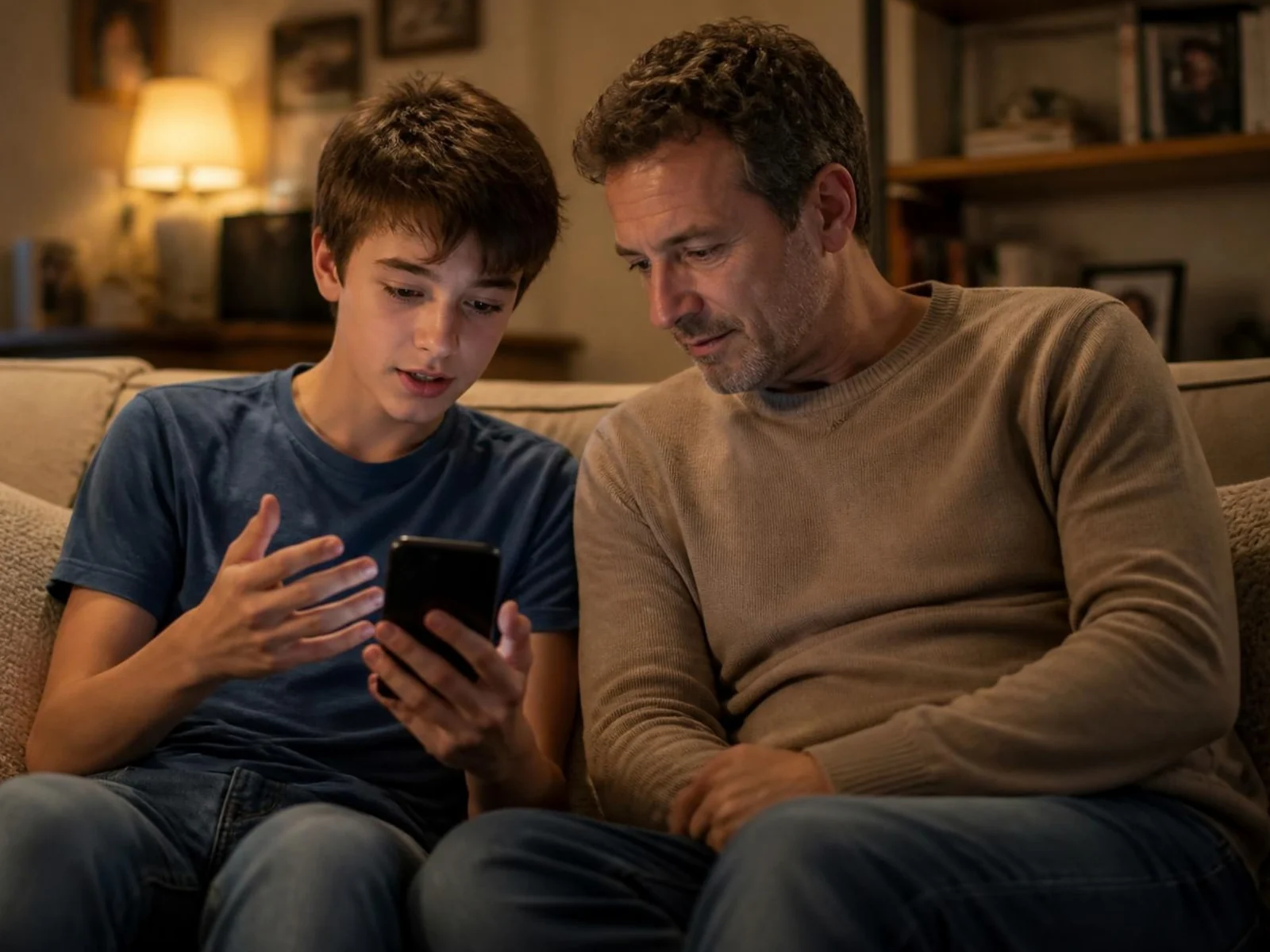
Many young people already use AI for school and in their free time. According to the JIM study 2025, a German survey of young people's media use, 91 per cent of 12 to 19-year-olds use at least one AI application, up from 62 per cent a year earlier. Many parents wonder whether their child is learning with it or letting it do the work.
You do not need to be an expert to guide your child well. Three things count: your child uses AI to understand things, knows what does not belong in a prompt, and you keep talking about it.
What children use AI for
Young people mainly use AI for homework and studying, for looking up information and to have things explained to them. Among 12 to 19-year-olds who use AI, 74 per cent use it for homework or studying, 70 per cent for looking up information and 54 per cent to find out how something works.
The most important application is ChatGPT: 84 per cent of 12 to 19-year-olds have used it. Around a third each use Google Gemini and Meta AI at least once in a while, and around a fifth use Snapchat's My AI. So your child also comes across AI in apps they already use.
Of 12 to 19-year-olds, 57 per cent consider information from AI to be largely or completely trustworthy, even though AI also makes false claims. Only 6 per cent trust it completely. So talk to your child about the limits of AI.
From what age AI is allowed
Age limits are set out in the terms of use and vary. ChatGPT allows use from age 13, and under 18 only with parental consent. Other providers require users to be 18, such as Anthropic for Claude. Check the terms of use of each service.
- If your child is under 13, then ChatGPT is not intended for them under its terms of use. Rather than setting up an account for them, explore AI with them together.
- If your child is between 13 and 17 and wants to use ChatGPT, then they need your consent. Then agree the family rules below together.
- If a service requires users to be 18, then it is not intended for your child, not even for homework.
- If the school specifies a tool, then the school's rules apply to it. At schools in Hesse, the German state, students use the state's AI tool, AIS.chat, via links or QR codes that their teacher creates for lessons. Read more in the article AI in schools in Hesse.
Is your child learning or copying?
Whether AI helps with learning depends above all on how your child asks. Three questions you can ask with every piece of homework:
- Before: “What do you want to learn today?”
- During: “Is the AI explaining, or is it solving?”
- After: “Now explain it to me without AI.”
An example with percentages. The task reads: A jacket costs 80 euros and is reduced by 25 per cent. What does it cost now? If your child simply types in the task, the AI delivers the finished answer. Your child can copy it without knowing how to work it out.
With a different prompt, the AI explains instead of solving. A template your child can adapt:
- “I'm in grade [7] and practising [percentages]. Explain the topic to me step by step and ask me a question after each step. Don't tell me any answers, at most give me a hint.”
The AI then asks, for example: “What is a quarter of 80?” Your child answers: “20. So 60 euros!” They have found the method themselves. If you ask about it afterwards, they can also explain it.
Also ask what the teacher allows for this task. If the worksheet says nothing about it, your child can ask in the next lesson. If they used AI, a short sentence under the task helps, such as “Outline with AI, text written by me.” That way, the teacher can see which parts come from your child.
A template for family rules
Rules stick better when everyone writes them down together. You can go through the following template with your child and fill in the gaps together. Put the result up where your child does their homework.
- Think for yourself first, then ask.
- Use AI to explain, not to copy. The AI explains, you do the task.
- Do not enter personal data, photos or addresses. We never upload photos of other people.
- Check answers: Is that right? How do I know?
- We use these AI apps: [list]. We talk about new apps first.
- After [time], we stop chatting with AI.
- When we are unsure about something, we raise it openly. We talk about worries with each other.
- In [three months], we will check together whether the rules still work.

What to look out for
According to the JIM study 2025, only around a third of young people feel confident about recognising deepfakes. Fake images and videos are therefore a topic for the whole family. Three situations and what you can do:
- If homework suddenly seems too easy, then ask your child to explain the solution without AI.
- If your child often chats with a chatbot, or does so at night, then ask with genuine interest what about and agree set times. If a chatbot seems like a friend to your child, or your child withdraws, talk to them and get support if needed, for example from the school.
- If your child shows you a surprising image or video, then check it together: Where does it come from, and who published it first? Does it fit the place, time and occasion? Do independent sources confirm what it shows?
Trying it out together
Try AI out together: ask your child to show you what they do with it, and ask it a question yourself. This gets you talking. Three small exercises work well for a first evening together:
- Ask the AI something you know the answer to, such as about where you live or one of your child's hobbies. Check together what is correct.
- Ask the AI for a source for a claim and search together to see whether it exists. AI can invent sources.
- Let your child try the sample prompt above with a topic from their current homework.
Next steps
- Ask your child which AI apps they use and what for.
- Check the age limit in the terms of use for each app.
- Fill in the family rules template together.
- Ask the three questions with the next piece of homework.
If you would like to raise the topic at your child's school, for example on the school parents' council: lindenbrook offers schools a 90-minute AI parents' evening, at the school or online. All parents receive a guide with a template for family rules. For teachers and school leadership, the article Tasks that show students' own thinking offers ideas for lessons.
Which AI app does your child use most often, and have you ever tried it out together?
Frequently asked questions
Should I ban AI?
A ban can hardly be enforced. Firm agreements and an interest in what your child does with AI work better.
How can I tell whether my child is copying?
Ask how they reached the answer. Anyone who has understood something themselves can explain it in their own words.
From what age may my child use ChatGPT?
Under its terms of use, from age 13, and under 18 only with parental consent. Other providers require users to be 18, such as Anthropic for Claude. What applies to a service is set out in its terms of use.
What may my child enter into an AI tool?
No personal data, photos or addresses, and no photos of other people. Questions about school material without personal details are well suited. If in doubt, it is better to enter nothing and ask.
I barely know anything about AI myself. Can I still guide my child?
Yes. You do not need to be an expert. Ask your child to show you how they use AI, and ask the three homework questions. Interest and firm agreements help more than technical knowledge.
Sources
- mpfs, JIM study 2025 (in German)
- mpfs, JIM study 2025, report, PDF, pp. 63 to 67 (in German)
- OpenAI: Terms of Use (EU)
- Anthropic: Consumer Terms of Service
Updated: . This article is not legal advice.